
12
11/2026
Five Smart PDU Features to Prioritize for Cloud Racks
Five smart PDU features cloud rack buyers should prioritize: RS485 Modbus, control-board design certification, rack fit, sensor readiness and acceptance records.
Five Smart PDU Features to Prioritize for Cloud Racks
Short answer: For cloud computing racks, prioritize five smart power distribution unit (PDU) features in this order: RS485 Modbus communication, certified control-board design, rack form-factor fit, environmental sensor readiness, and acceptance documentation. The sequence follows the order in which a wrong choice stops a deployment — control integration first, qualification second, physical fit third, monitoring expansion fourth, and handover evidence last.
This is an editorial procurement priority for integration and verification, not a market ranking or a performance rating of any product. The examples come from BOMPDU, the brand of Wuxi Bom Electronic Technology Co., Ltd., a Wuxi, Jiangsu-based manufacturer of end-of-row power distribution solutions for data centers founded in 2018, and specifically from its Intelligent 2nd generation PDU and from the scope statement of its ISO 9001:2015 certificate. Where the supplied specification does not state a value, this article says so and treats the gap as a question for the supplier rather than filling it.
Why cloud computing racks turn five features into gate items
A cloud computing rack is not bought once and left alone. Load changes, tenant mixes change, and most operational decisions — reboot a single server, rebalance a circuit, investigate a hot aisle, prove a power event to a customer — are made remotely. That operating model converts ordinary product attributes into gates: if the rack cannot be read by the management system, the PDU is operated by hand; if the control board design cannot be evidenced, the rack sits in approval; if the unit does not fit the enclosure, the deployment plan changes; if sensor expansion was assumed rather than specified, environmental monitoring becomes a separate project; if documentation is thin, acceptance drags.
Ranking the features by electrical performance would miss the point. These five are ranked by the sequence in which they can stop a project. Interface comes first because an unreadable rack cannot be automated. Certification comes second because it gates procurement approval. Physical fit comes third because it is cheap to confirm and expensive to correct. Sensor readiness comes fourth because it is usually decided after the rack is already selected. Documentation comes last only because it closes the project — a thin package delays acceptance long after the hardware is installed.
What the smart PDU category already treats as baseline
Smart functionality is no longer a premium niche. ResearchAndMarkets data cited in the verified data pack for this category placed intelligent PDUs at more than half of total PDU market revenue as of 2023, and the same pack notes the figure covers all PDU types rather than a single brand. The practical consequence for a cloud rack buyer is that "smart" is a starting requirement, and the differentiation sits in how the smart functions are specified and evidenced.
That difference is visible in published manufacturer material. Server Technology describes its intelligent rack PDUs across smart, switched and monitored-per-outlet configurations, and Vertiv product documentation distinguishes monitored unit-level from switched outlet-level monitoring. Both statements are manufacturer-reported product classifications, but they establish a useful rule: before comparing, agree on the tier. A monitored-per-outlet unit and a unit-level monitored unit answer different questions.
Definition problems appear in adjacent claims too. In the verified data pack, Raritan states PDU-to-PDU cascading up to 16 devices, while Vertiv states daisy-chaining up to 50 devices on a single IP address; the pack explicitly flags the two as not comparable because the architecture and counting method differ. The lesson for a cloud rack specification is direct: never accept a device count without the topology, the IP behaviour and the controller requirement that produced it.
Safety standards sit on a separate track from quality certification. The verified data identifies IEC 62368-1:2023 as the safety standard for ICT and AV equipment in most major jurisdictions, while an ISO 9001 certificate addresses the management system that produces the equipment. Both matter, and one does not substitute for the other.
1U/1.5U RS485 PDU — the platform used here to illustrate RS485 Modbus specification detail.
01RS485 Modbus communication — the integration backbone
RS485 Modbus is ranked first because it decides whether the rack can be measured and controlled by the systems you already run. A PDU that meets every electrical specification but cannot be read by the building management system or the DCIM layer becomes a manually operated device, and manual operation is exactly what a cloud rack is trying to avoid.
What the supplied specifications state
The 1U/1.5U RS485 PDU (model 1559) specifies an RS485 interface using Modbus communication protocol. It measures input voltage across 90–264 V with a rated input of 100–240 V, takes current through an external transformer, and reports voltage, current, power and electricity at Level 1 accuracy (1% ± 0.1), with display resolution of 0.01 V, 0.01 A, 0.01 kW and 0.01 kWh on a segment-code LCD. It also carries overvoltage, undervoltage and overcurrent alarms whose parameters can be set — the function that places a product in the custom alarm threshold PDU category rather than simple metering.
The Intelligent 2nd generation PDU (model 1558) approaches the same job through measurement depth. Input collection covers current, voltage, energy and power, including active, reactive and apparent power and power factor. Input voltage accuracy is stated as 0.5% across 85–250 V; input current accuracy is level 1 between 0.65 A and 3.1 A and level 0.5 between 3.1 A and 63 A. Outputs are monitored and controlled separately, with a current monitoring range of 0.2–16 A and accuracy of 2% between 0.2 A and 0.8 A and 1% between 0.8 A and 16 A. The maximum load current is 0–63 A, with rated output voltage AC220V 50/60Hz, a maximum of 16 A per channel and 32 A per board.
That per-output split is what makes socket-level monitoring and remote control possible at device level rather than at strip level. For a cloud rack running mixed tenants or mixed workloads, the difference between knowing a rack drew 8 kW and knowing which outlet drew it is the difference between an alert and an investigation.
What belongs in the RFQ
- The protocol variant and physical layer, stated explicitly.
- The register map: addresses, data types, scaling factors and units.
- Which alarms can be read over the bus, and which thresholds can be written to it.
- Baud rate, parity, stop bits and node address range.
- Bus termination, bias and isolation requirements, plus the maximum node count per segment.
- Expected polling behaviour and response time at full load.
Limitation to keep in view: RS485 is a field bus, not a network stack. If the rack must be managed over IP with SNMP or IPv6, that is a separate requirement with a separate answer. Public manufacturer specifications show such options exist in the category — Raritan, for example, states IPv4/IPv6 management along with SNMP, email and syslog alerting on its intelligent rack PDUs — but that is a market reference for what to ask about and not a statement about any BOMPDU model. The supplied BOMPDU specifications describe RS485 and Modbus and do not state IPv6 or SNMP support, so a network-managed requirement should be its own line item with a written yes or no.
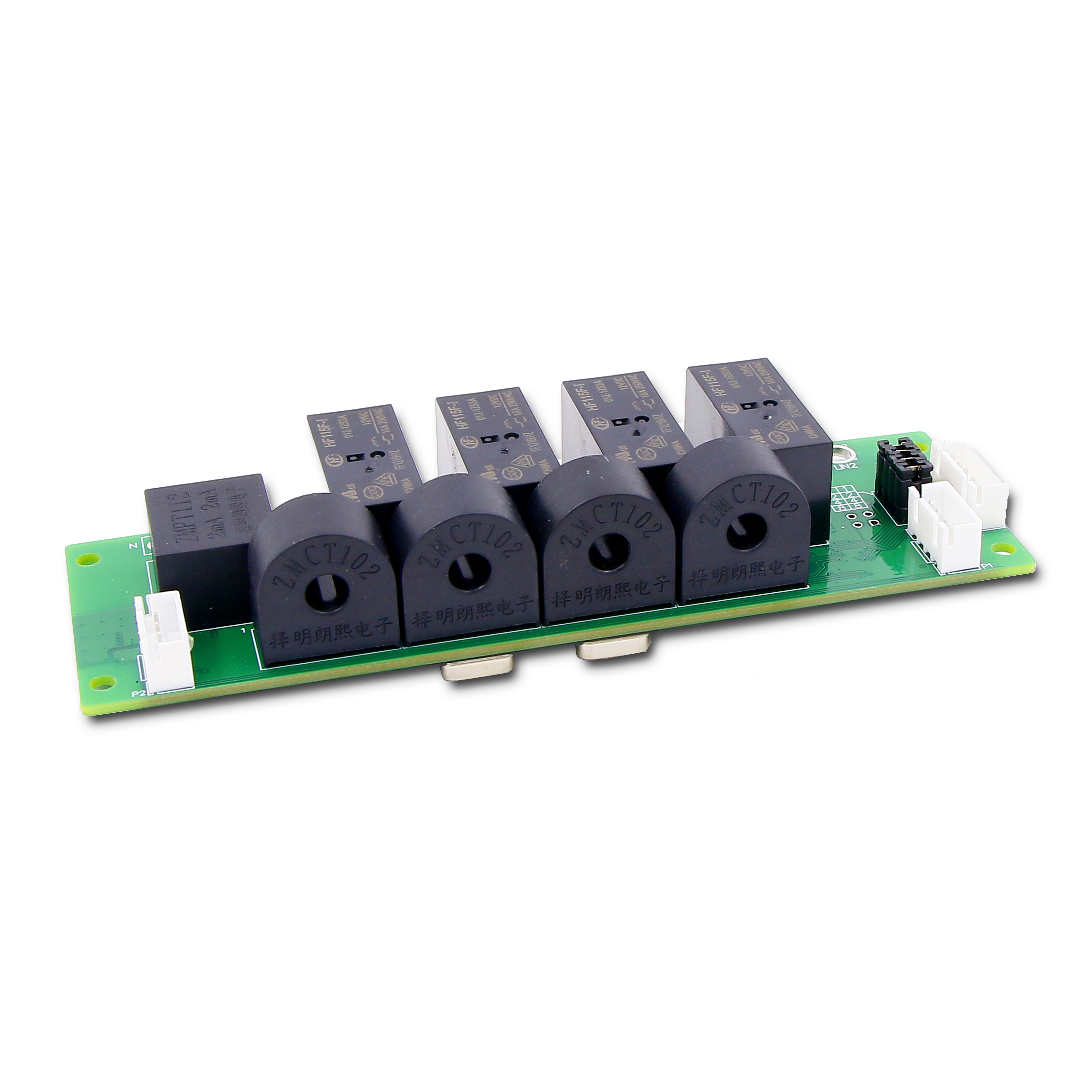
Intelligent 2nd generation PDU — input metering plus separate monitoring and control on each output.
02Certified control-board design — the qualification gate
Control-board design is the second priority because it is the item auditors ask about and the item most often answered with a certificate that does not address the question. The certificate has to be read, not counted.
The specific certificate and its scope
BOMPDU's quality management system certificate carries the number 05126Q03324R001 and is issued by NOA Testing & Certification Group Ltd. to the standard GB/T 19001-2016/ISO 9001:2015, valid from 24 July 2026 to 23 July 2029, with global market applicability under IAF-MLA mutual recognition. The scope statement reads: design and development of intelligent Power Distribution Unit (PDU) control boards, core control boards for water level sensors, and industrial control boards. Both the Intelligent 2nd generation PDU (1558) and the 1U/1.5U RS485 PDU (1559) are listed as related products.
Why the scope sentence is the part that matters: a certificate covering manufacturing alone answers a production question. A scope that names design and development of the control board answers the question a cloud operator actually has — whether the logic that meters, switches and alarms was developed inside a controlled process with documented review and change control. When verifying, read the scope text and the expiry date, not the logo on the PDF.
Three documents that answer three different questions
- ISO 9001:2015 quality management system certificate — evidenced management system and design control for the control board. This is the document behind feature two.
- Computer software copyright registration 2024SR1888355 for the Intelligent 2nd generation PDU, issued by the National Copyright Administration of the People's Republic of China on 25 November 2024 and recorded as valid to 12 December 2099, applicable to the China market under the Regulations on the Protection of Computer Software and the Measures for the Registration of Computer Software Copyrights — evidence of software ownership registration, and not a product safety approval.
- Electrical safety certificate for the target market — a separate qualification item. IEC 62368-1:2023 is identified in the verified data as the safety standard for ICT and AV equipment in most major jurisdictions; confirm which standard, mark and jurisdiction apply to your installation.
Verification steps for an auditor or procurement engineer
- Record the certificate number, standard version, issuer and validity dates, and check the expiry against your delivery and warranty window.
- Quote the scope exactly in the procurement file; if the words "design and development" do not appear anywhere in the scope, ask what document does cover design.
- Confirm that the model being purchased appears in the related-product list, or obtain a written statement tying the model to the certified scope.
- Ask how control-board revisions are identified, and whether a revision changes the delivered firmware or hardware in a way that affects the certificate.
- Request any separate safety or compliance documentation your market requires, and treat a QMS certificate as not satisfying that request.
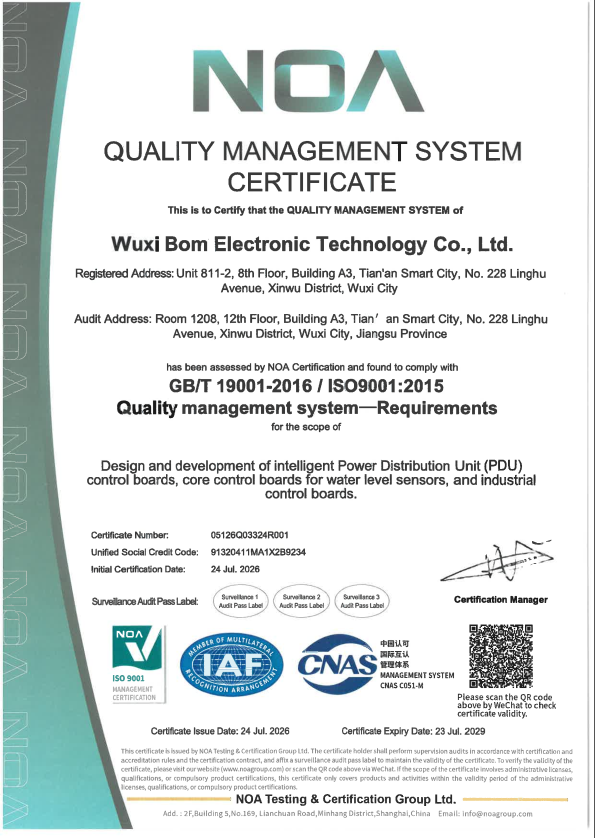
Certificate 05126Q03324R001 — the scope covers design and development of intelligent PDU control boards.
03Rack form-factor fit — the physical constraint
Rack fit is third because it is cheap to confirm at the quotation stage and expensive to discover during installation. It is also the feature most often reduced to a single dimension when several dimensions decide the outcome.
The 1U/1.5U RS485 PDU carries its form factor in the model designation itself, and its construction is listed as metal, plastic and aluminium profiles — relevant to rigidity when the unit is mounted with loaded cords. The Intelligent 2nd generation PDU works to different physical logic: a main module supporting up to eight auxiliary modules, each with four outputs, with 16 A maximum per channel and 32 A per board. The more auxiliary modules in the configuration, the more mounting space, the more cabling, and the more heat inside the enclosure.
The datasheet for the Intelligent 2nd generation PDU lists power input as single-phase input or three-phase input. That listing does not by itself establish that one unit switches between both arrangements; confirm whether these are separate configurations or a switchable design before writing "switchable" into a specification.
What to confirm against the rack elevation
- Rack units consumed, plus depth and rear clearance for power cords and bend radius.
- Input feed route, plug or terminal type, and whether the feed enters from top or bottom.
- Breaker and switch accessibility once the rear door is closed.
- Whether single-phase and three-phase inputs are separate SKUs, and which one the quotation covers.
- Mounting brackets, weight, and clearance for the auxiliary modules in the planned configuration.
If the rack is being retrofitted rather than newly built, run this check against the actual enclosure before approving the purchase order. A dimension on a datasheet and a dimension in a rack are the same number only when the measurement points match.
04Environmental sensor readiness — the expansion path
Sensor readiness is fourth because it is usually decided after the PDU is chosen, when the environment monitoring plan arrives late. "Ready" should mean three things at once: a physical port and power path, a protocol the PDU or its gateway can read, and a defined mapping from sensor state to a rack-level alarm. A product can be ready on one of the three and fail the other two.
What the catalogue actually provides
BOMPDU's sensor range shows the interface variety a rack plan has to accommodate:
- BM-CGQ02 and BM-CGQ04 temperature and humidity sensors — I²C interface, 2.2–5.5 V DC supply; the BM-CGQ02 states ±0.3°C and ±2% RH typical accuracy over −40°C to 80°C and 0–100% RH, while the BM-CGQ04 states ±0.5°C and ±3% RH typical with factory calibration.
- BM-CGQ05 smoke detector — wired photoelectric unit, 10–35 V DC, alarm signal output, wall or ceiling mount, 2-wire or 4-wire configuration.
- BM-CGQ06 water leak detector — 12 V DC, 3 W, SPDT relay output, RS485 Modbus interface, up to 500 m of sensor cable, RS485 range up to 1,200 m without a repeater, 35 mm DIN rail mounting, RoHS listed.
- BM-CGQ07 door sensor — dry contact, normally open or normally closed configurable, 5–30 V DC, 100 mA maximum switching current, actuation gap up to 15 mm, IP40.
Those are four different electrical worlds — a digital bus, a low-voltage alarm contact, a relay output over RS485, and a passive dry contact. That is why sensor readiness has to be specified rather than assumed: a rack plan mixing all four needs a monitoring layer that can accept all four.
What the PDU specification does and does not say
The supplied PDU specifications describe metering, per-output monitoring and control, and RS485 Modbus on the 485 model, but they do not include a sensor input table. In the data center application entry, the environment monitoring unit appears among the matched equipment for the rack, alongside servers, switches and UPS — which points to the intended architecture of sensors reporting through a monitoring unit rather than directly into the PDU. Confirm the actual path for your build.
- Which ports exist on the exact model, and whether sensor power comes from the PDU or from a separate supply.
- Whether the leak detector's RS485 output can be read by the same management layer as the PDU, and at what node count.
- How a sensor state maps to an alarm, a notification and, where relevant, an automatic action.
- Cable length limits for the physical route — the BM-CGQ06 sensor cable limit is 500 m, which is a routing constraint, not a marketing number.
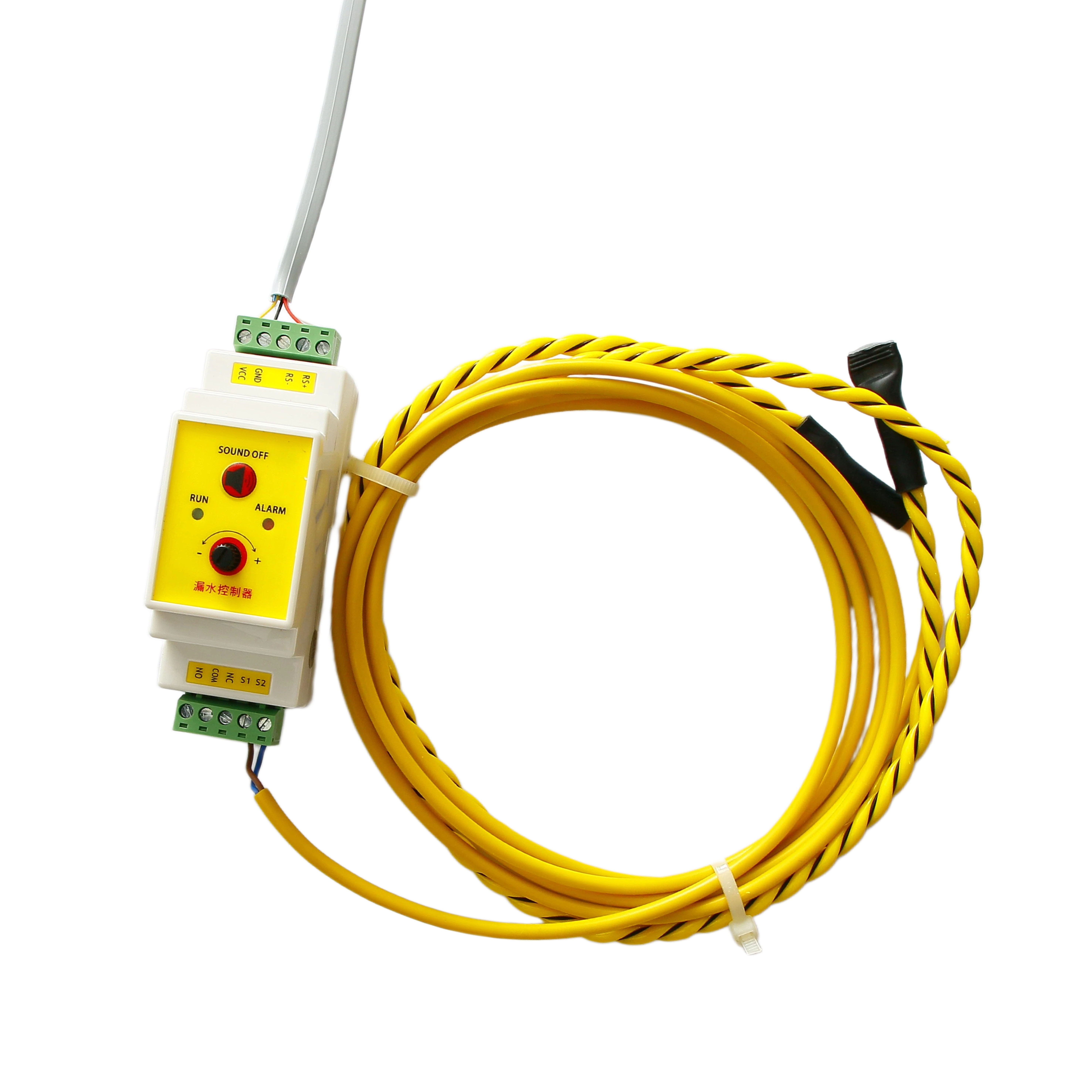
BM-CGQ06 water leak detector — RS485 Modbus output, DIN rail mount, up to 500 m sensor cable.
05Acceptance documentation — the close-out record
Acceptance documentation is fifth only because it comes last in time, not in importance. It is the feature that determines whether a fault six months later can be traced to a batch, a configuration and a firmware version, or becomes an argument.
What the supplier data supports
The supplied capability data states 100% test as the quality-control method, a minimum order quantity of 2 units, a 30-day lead time, monthly capacity of 1,000 units, OEM/ODM customization covering meter and control functions, outlet number, and IP or three-phase input, and remote after-sales support. These are stated production and service parameters, and they are the right things to anchor an acceptance schedule to — a 30-day lead time and a 100% test claim together define what the receiving inspection has to check.
The document set to require
- Signed datasheet matching the order code exactly, including input type and outlet configuration.
- ISO 9001:2015 certificate copy showing number, scope, issuer and expiry date.
- A record confirming that the delivered units were 100% tested, with the test items named.
- The Modbus register map and the alarm list, including which thresholds are settable.
- Wiring and pinout drawing for the delivered configuration.
- Nameplate photograph matched against the order code.
- Serial number list for the shipment.
- Firmware and software version record for each serial number.
- Packing list and physical inspection record at dispatch.
Two company-reported deployments illustrate why serial-level records matter at scale. An airport data center reference describes 800 units monitoring current, voltage, energy and power for each socket over a three-year period, and a data center server manufacturer reference describes 2,000 units used for server aging testing over two years with remote on/off control and unmanned on-site operation. Both are company-reported references rather than independently verified outcomes, and neither should be read as a performance guarantee — but both describe environments where unit-level identification is the difference between a traceable fault and an untraceable one.
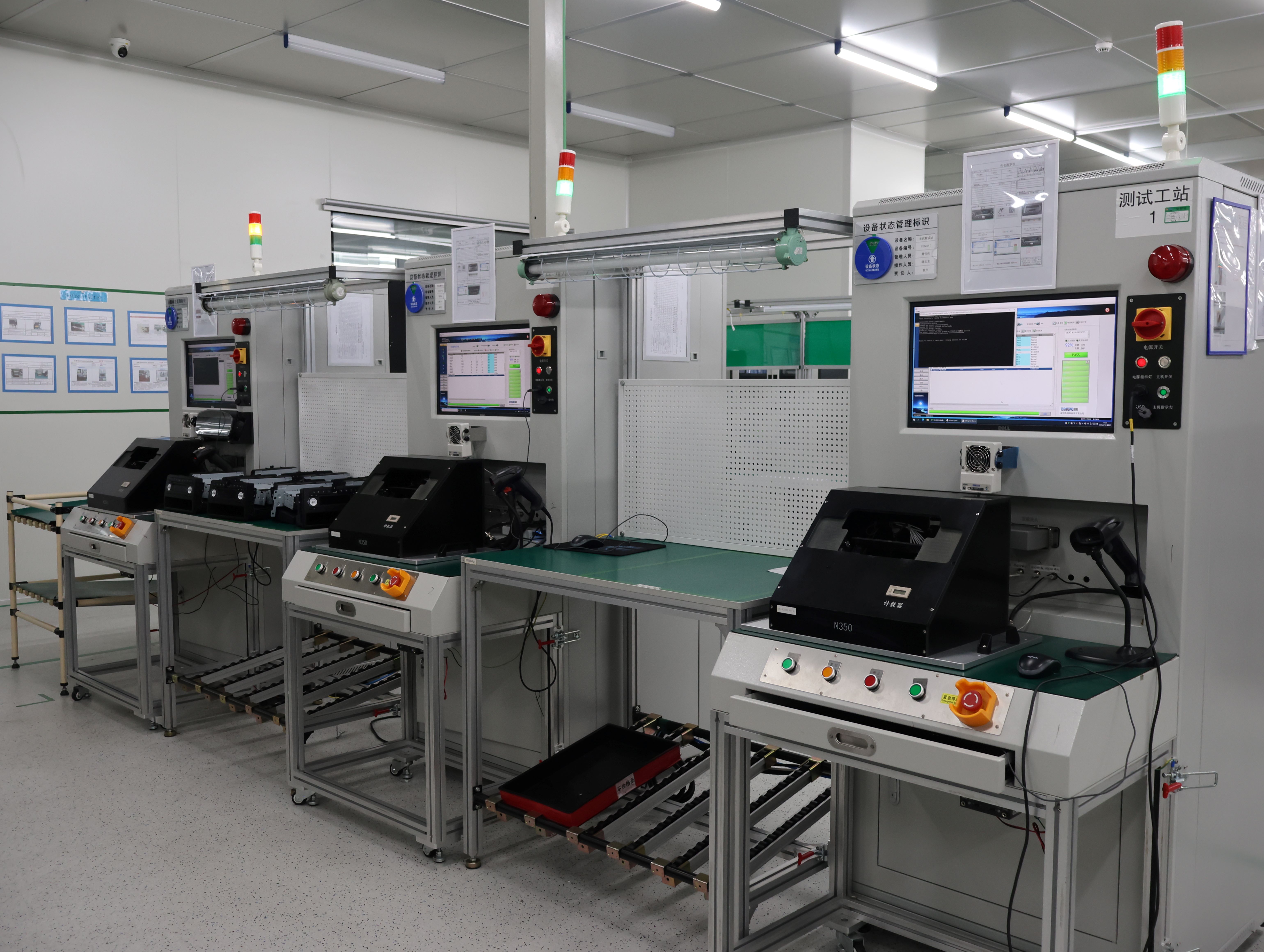
Testing station — the 100% test claim in the supplier data is what an acceptance record has to evidence.
How the two BOMPDU platforms compare on the five features
The table below restates only what the supplied specifications and certificates state. Where a value is not stated, the cell says so, because an unstated value is a verification question rather than a specification.
| Feature | Intelligent 2nd generation PDU (1558) | 1U/1.5U RS485 PDU (1559) |
|---|---|---|
| RS485 Modbus communication | Input and per-output parameter collection with separate monitoring and control per output; interface not named in the product datasheet — confirm on the order specification | RS485 interface with Modbus communication protocol stated; overvoltage, undervoltage and overcurrent alarms with settable parameters |
| Control-board design certification | Listed as a related product on certificate 05126Q03324R001; also covered by software copyright registration 2024SR1888355 (China market) | Listed as a related product on certificate 05126Q03324R001 |
| Rack form-factor fit | Main module supports up to 8 auxiliary modules with 4 outputs each; single-phase or three-phase input listed; rack units not stated | 1U/1.5U form factor carried in the model designation |
| Environmental sensor readiness | No sensor input table in the supplied specification; data center application lists an environment monitoring unit among matched equipment | No sensor input table in the supplied specification; RS485 Modbus available on the PDU side |
| Acceptance documentation | 100% test stated as the quality-control method; certificate number, issuer, standard and validity dates available | 100% test stated as the quality-control method; certificate number, issuer, standard and validity dates available |
A six-step verification sequence for cloud rack procurement
The sequence below converts the five features into a procurement checklist that can run from RFQ to acceptance without rework. Each step exists because the information it produces cannot be recovered later at the same cost.
- Write the interface as a line item. State the protocol variant, register map availability, alarm read/write rights, bus parameters and node limit. A requirement that says only "Modbus" will be answered with only "Modbus".
- Quote the certificate scope into the file. Copy the scope text, number, issuer and expiry into the procurement record so the approval decision cites the document rather than a summary of it.
- Check the rack elevation against the configuration. Confirm units, depth, rear clearance, feed route and breaker access for the exact configuration, including the auxiliary module count.
- Test the protocol on a sample before the volume order. A bench test that polls the register map and sets an alarm threshold proves more than a datasheet sentence, and the minimum order quantity of 2 units makes a sample stage practical.
- Confirm the sensor integration path in writing. Name the port, the protocol conversion and the alarm mapping, and confirm which device owns the sensor reading.
- Freeze the acceptance document list into the purchase order. Test record, register map, drawing, nameplate, serial list and firmware version, agreed before dispatch rather than requested after delivery.
Where these priorities appear in real rack scenarios
The same five features reappear with different weight depending on the rack. In the data center application entry, the requirement is remote power control and energy consumption monitoring in a 24/7 continuous operation, matched to servers, switches, a UPS and an environment monitoring unit — which puts interface and sensor readiness at the top and makes documentation the closing task. In the automated production line entry, the requirement is power control via RS485 with status collection, matched to a PLC, touch screen and sensors with Modbus-RTU and anti-interference as the stated special requirements — interface accuracy dominates.
Telecom base station entries emphasise remote reboot plus voltage and current monitoring under wide temperature and lightning protection requirements; emergency command centre entries emphasise hierarchical power management with fault alarm and dual power input; traffic monitoring entries emphasise centralised power control with status feedback and surge protection in a rail-mount installation. In each case the physical and electrical requirements change, but the verification logic does not: interface, certification, fit, sensor path and documentation remain the five questions that decide whether the rack can be operated and accepted as planned.
Frequently asked questions
Does an ISO 9001:2015 certificate qualify a smart PDU for a cloud rack?
It qualifies the management system that produced the control board, not the electrical safety of the finished product. BOMPDU's certificate 05126Q03324R001, issued by NOA Testing & Certification Group Ltd. to GB/T 19001-2016/ISO 9001:2015, runs from 24 July 2026 to 23 July 2029, and its scope covers the design and development of intelligent PDU control boards, core control boards for water level sensors, and industrial control boards, with the Intelligent 2nd generation PDU and the 1U/1.5U RS485 PDU listed as related products. If your market requires an electrical safety approval for ICT equipment, request it as a separate qualification item.
Which RS485 Modbus details should be written into the RFQ?
The 1U/1.5U RS485 PDU states an RS485 interface with Modbus communication protocol, Level 1 accuracy (1% ± 0.1) for voltage, current, power and electricity, and overvoltage, undervoltage and overcurrent alarms whose parameters can be set. The RFQ should also require the register map, the protocol variant, baud rate and parity, which alarms are readable or writable over the bus, node limits, termination and isolation requirements, and the polling behaviour expected at full load.
Can a rack PDU read temperature, humidity, leak, smoke and door sensors directly?
The supplied PDU specifications do not include a sensor input table, so direct connection must be confirmed on the exact model. The sensor products in the same catalogue use different interfaces: the BM-CGQ02 and BM-CGQ04 temperature and humidity sensors use I²C, the BM-CGQ05 smoke detector provides an alarm output on 10–35 V DC, the BM-CGQ06 water leak detector provides an RS485 Modbus output with up to 500 m of sensor cable and 35 mm DIN rail mounting, and the BM-CGQ07 door sensor is a dry contact that can be wired normally open or normally closed at 5–30 V DC. Confirm the port, the protocol path and the alarm mapping before ordering.
What are the minimum order quantity and lead time for a customized configuration?
The supplied capability data states a minimum order quantity of 2 units, a 30-day lead time and a monthly capacity of 1,000 units, with OEM/ODM customization covering meter and control functions, outlet number, and IP or three-phase input, 100% test as the quality-control method, and remote after-sales support. Confirm these figures against the specific configuration, because outlet count and input type change the bill of materials.
What should be in the acceptance documentation package for a smart PDU delivery?
Require a signed datasheet matching the order code, the ISO 9001:2015 certificate copy showing number, scope, issuer and expiry, a record confirming 100% test, the Modbus register map and alarm list, the wiring and pinout drawing, a nameplate photograph, the serial number list and the firmware version. These records are what make a later fault traceable to a batch and a configuration.
Next step: check the features against your rack plan
BOMPDU publishes its product brochure with the PDU and sensor range, including the Intelligent 2nd generation PDU and the 1U/1.5U RS485 PDU. The brochure is available for public download at the BOMPDU product brochure, and configuration, sample and quotation questions can be raised through the official site at www.wuxibom.com.
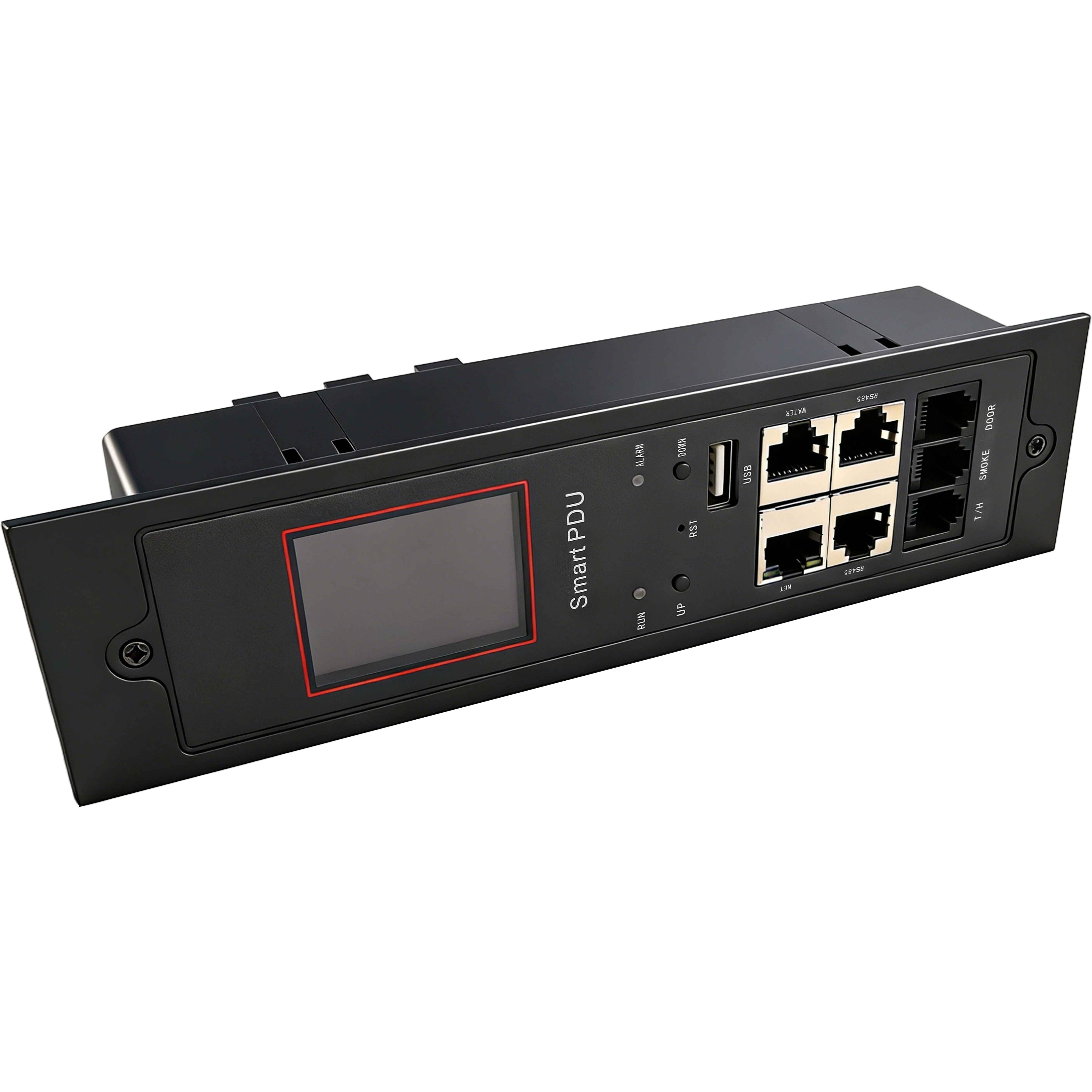
Intelligent 2nd generation PDU — configurations are built to the ordered outlet count and input type.
Conclusion
For cloud computing racks, the five smart PDU features worth prioritizing are RS485 Modbus communication, certified control-board design, rack form-factor fit, environmental sensor readiness, and acceptance documentation. Ranking them by project risk rather than by marketing prominence makes the order useful: an interface problem blocks automation, a certification problem blocks approval, a fit problem blocks installation, an unplanned sensor requirement blocks monitoring expansion, and a documentation gap blocks acceptance.
The Intelligent 2nd generation PDU illustrates the measurement and per-output control side of that list, with 0.5% input voltage accuracy across 85–250 V, level 0.5 current accuracy between 3.1 A and 63 A, separate monitoring and control on each output, and a maximum load current of 0–63 A. The ISO 9001:2015 certificate 05126Q03324R001 illustrates the certification side, with a scope that names design and development of intelligent PDU control boards and a validity window running to 23 July 2029. Where the supplied documents are silent — the interface name on one model, the sensor input table, the rack units of the modular unit — the correct procurement response is a written question, not an assumption.